Service Area: Belgium and European Drivers
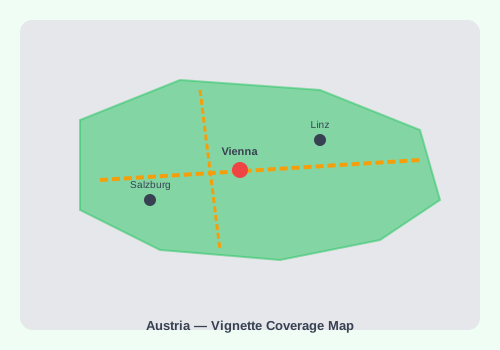
Austrian Motorway Coverage
The Austrian vignette covers the entire ASFINAG-managed motorway (Autobahn) and expressway (Schnellstrasse) network, totalling approximately 2,200 kilometres of high-speed roads. This network connects all major Austrian cities and provides the primary transit routes through the country.
The network includes the major east-west corridor (A1 Westautobahn from Vienna to Salzburg), the north-south Brenner corridor (A13, with additional toll), and the southern routes connecting Austria to Slovenia and Italy.
Common Routes from Belgium to Austria
| Route | Entry Point | Distance (approx.) | Notes |
|---|---|---|---|
| Brussels → Vienna via Germany | Salzburg/Walserberg | ~1,300 km | Most common route; uses A1 in Austria |
| Brussels → Innsbruck via Switzerland | Bregenz/Hohenems | ~1,100 km | Shorter but requires Swiss vignette too |
| Brussels → Graz via Germany/Slovenia | Spielfeld | ~1,450 km | Southern route; uses A9 in Austria |
| Brussels → Salzburg via Germany | Salzburg/Walserberg | ~1,100 km | Popular for ski resorts |
Key Entry Points into Austria
The following border crossings are the most commonly used by drivers from Belgium and Western Europe. Vignette purchase facilities are available at or near most of these crossings.
- Salzburg/Walserberg (A8/A10): Main entry from Bavaria; petrol stations and border shops with vignettes available.
- Bregenz/Hohenems (A14): Entry from Switzerland; note the Arlberg tunnel requires an additional toll.
- Kufstein (A12): Entry from Bavaria on the Inn Valley motorway; petrol stations available.
- Suben (A8): Entry from Bavaria on the Innkreis motorway; border shop available.
- Spielfeld (A9): Entry from Slovenia; southern route.
- Nickelsdorf (A4): Entry from Hungary; eastern approach to Vienna.
Local Nuances for Belgian Drivers
Drivers from Belgium should be aware of the following specific considerations when planning a journey to Austria:
- Swiss vignette required separately: If your route passes through Switzerland, you will need a separate Swiss vignette (annual only, CHF 40). The Austrian and Swiss vignettes are entirely separate systems.
- German motorways are free: Germany does not currently require a vignette for foreign-registered passenger cars, so no additional purchase is needed for the German section of your journey.
- Brenner Pass additional toll: If you plan to cross into Italy via the Brenner Pass, the A13 section in Austria requires an additional toll of approximately €11 per direction, in addition to the vignette.
- Tunnel tolls in the Alps: Several Alpine tunnels require additional payment. Plan your budget to include these if your route passes through them.
- Belgian registration plates: Belgian plates are in the standard European format and are fully compatible with the Austrian digital vignette system. Enter your plate exactly as shown on your registration document.
- Speed limits: Austrian motorway speed limits are generally 130 km/h, lower than some other European countries. Variable speed limits are common and enforced by cameras.
- Winter equipment: In winter conditions, snow chains or winter tyres may be required on certain Alpine routes. This is separate from the vignette requirement but important for safe travel.
- Emergency triangle and first aid kit: Austrian law requires vehicles to carry a warning triangle and a first aid kit. Belgian vehicles are typically already equipped with these, but verify before travel.
Toll Systems in Neighbouring Countries
If your journey passes through multiple countries, be aware of their respective toll systems:
| Country | System | Notes for Belgian Drivers |
|---|---|---|
| Germany | No vignette (cars) | Free for foreign-registered passenger cars |
| Switzerland | Annual vignette (CHF 40) | Mandatory if using Swiss motorways; separate from Austrian |
| France | Per-section tolls | Pay at toll booths; card payment accepted |
| Italy | Per-section tolls | Pay at toll booths; Telepass system available |
| Slovenia | Vignette | Separate from Austrian vignette |
| Czech Republic | Digital vignette | Separate system; purchase at asfinag.cz equivalent |
| Hungary | E-vignette | Separate system; purchase online |